5G vs 6G: What to Expect from the Next Generation of Mobile Connectivity
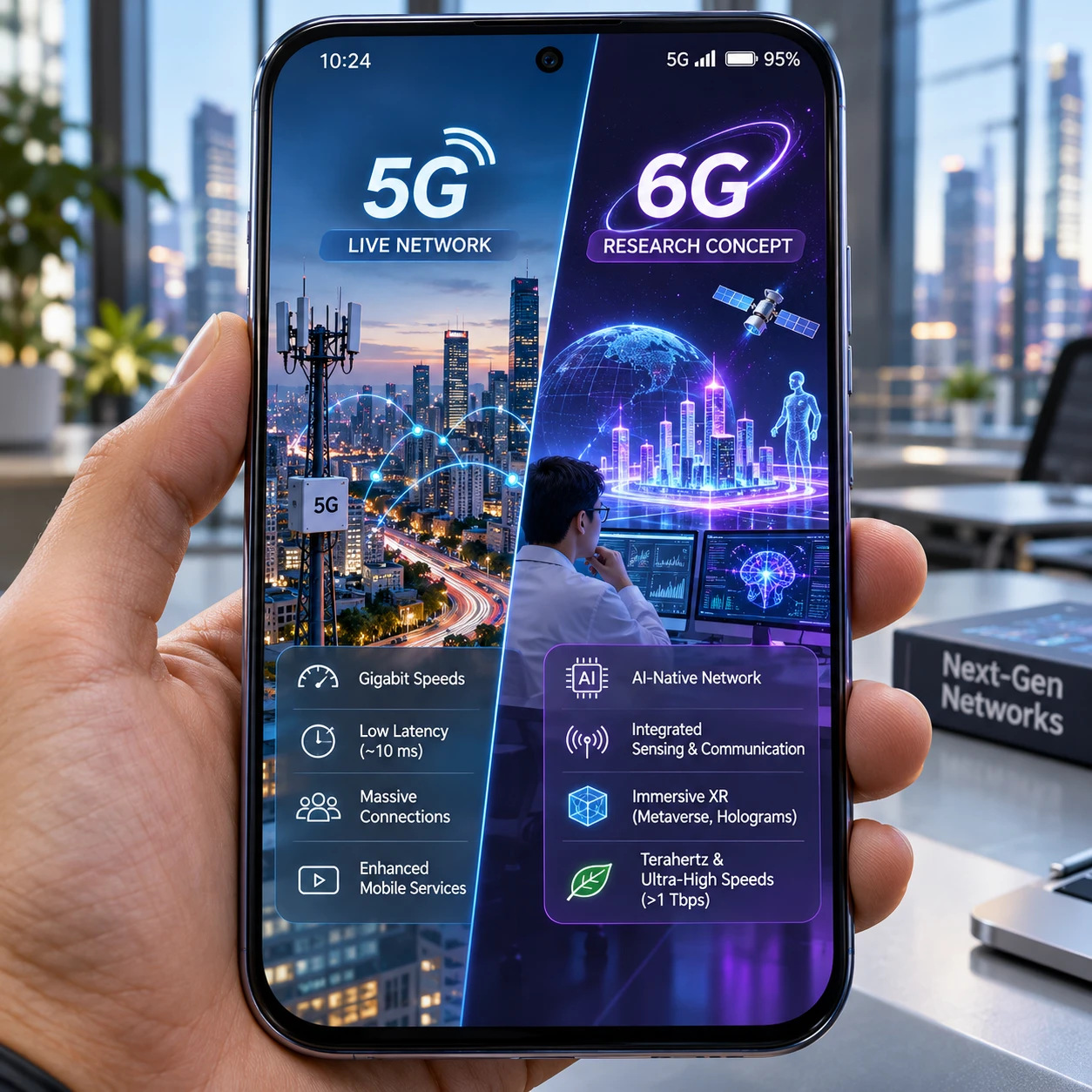
6G is the next generation of mobile connectivity being researched, while 5G is already operating on phones and networks around the world. The move from 5G to 6G may bring changes to speed, latency, network capacity, and how mobile networks use AI, but its specifications and consumer benefits are not settled yet.
For smartphone buyers, the practical question is less about chasing a number and more about timing. 5G is still expanding, and the first 6G services are years away. Here’s what is known, what remains a projection, and how to make a sensible phone decision today.
5G and 6G at a glance
5G is the current generation of mobile network technology, while 6G is a developing set of research and standards efforts for a future generation. The key distinction is deployment: people can use 5G today, but 6G is not a consumer service.
5G connects smartphones through a mix of radio spectrum bands. Depending on the band, network design, coverage, and congestion, it can deliver faster data and lower latency than older networks. Real-world performance varies widely; a 5G icon does not guarantee a particular speed or a better connection than strong 4G.
6G research explores how future mobile networks might combine communications with sensing, computing, and AI-based management. Those ideas are being studied, not sold as a finished system. Standards still need to be developed, and the eventual service could differ from today’s research proposals.
That distinction matters when reading headlines. A laboratory demonstration or ambitious target is not the same as a network that carriers have built, tested for reliability, and made available to compatible smartphones.
How 6G could differ from 5G
6G could aim for higher capacity, more responsive connections, and networks that use AI more deeply than current 5G. These are research goals, not guaranteed improvements every user will experience.
Speed gets the most attention, but it is only one part of the comparison. Future networks may use additional spectrum, including higher-frequency bands, to carry more data. Such spectrum can offer substantial capacity, but signals at higher frequencies generally cover shorter distances and can be more easily blocked. Wider coverage may therefore require more sites and careful network planning.
Latency, the time it takes data to travel between devices and network systems, may also improve in some settings. That could help applications that need rapid responses. Yet latency depends on more than the radio link: the distance to a server, network congestion, device hardware, and software all matter. A new generation label alone cannot make every app feel instant.
AI-native networks are another anticipated shift. Rather than treating AI as a tool added after the fact, designers may build automated optimization into network operations. This could help manage capacity and adapt connections to changing conditions. It also raises practical questions about reliability, security, and how complex systems are managed.
For a useful comparison, think in four categories: speed, latency, capacity, and network design. 6G may advance all four, but the balance will depend on standards, spectrum availability, carrier investment, and where a person is using a phone. Early 6G coverage is unlikely to appear everywhere at once.
What 6G could mean for smartphones
For smartphones, 6G could support richer media, more responsive cloud services, and connections to more devices. The everyday benefit will depend on whether apps and services make useful use of those capabilities.
Faster, more consistent connections could make large downloads or cloud-based tasks smoother in areas with strong coverage. Video calls might benefit from lower delays and fewer interruptions, while games that rely on remote processing could respond more quickly. But today’s phones already handle common activities such as streaming, navigation, and messaging well on many 5G networks.
Future phones may also interact with a wider range of connected devices. Researchers are exploring network sensing, where radio signals could help detect aspects of the environment as well as transmit data. That could support new services, but it does not mean a smartphone will automatically gain reliable indoor positioning or see through walls. Such functions would need to be designed, tested, and supported by devices and infrastructure.
There are trade-offs. More advanced radios and additional network features can add engineering complexity, and higher-capacity coverage may require denser infrastructure. Battery life, device cost, heat management, and the availability of compatible services will shape the experience just as much as peak network performance.
Use cases beyond faster downloads
Potential 6G use cases extend beyond faster downloads to connected devices, immersive media, and communications combined with sensing. These applications remain possibilities, and their practicality will depend on cost, coverage, privacy, and demand.
Some plausible areas of development include:
- Immersive media: Higher capacity and lower delays could help deliver interactive augmented- or virtual-reality experiences, especially when a device relies on cloud processing.
- Connected devices: Future networks may support large numbers of sensors and other devices in a defined area, although many existing connected-device needs do not require 6G.
- Network sensing: Research may enable networks to infer information about movement or surroundings from radio signals. The exact capabilities and privacy safeguards are still open questions.
- Reliable remote operations: More responsive links could assist certain industrial or remote-control tasks, but safety-critical uses need dependable systems and cannot rely on a mobile connection alone.
These examples are not a list of features you can expect on a 6G phone at launch. They illustrate what researchers are considering. A useful test for any claim is to ask whether it describes a working trial, a standards proposal, or a product available to consumers; those are very different stages.
When might 6G arrive?
6G is not available to consumers, and commercial rollout is generally expected around 2030, though that timing could change. Standards, spectrum decisions, equipment, and carrier deployments all have to come together first.
Mobile generations take years to move from research into everyday service. The process includes agreeing on technical standards, building and testing network equipment, allocating spectrum, and developing compatible devices. Carriers then roll out coverage in stages, usually starting in selected locations rather than switching an entire country at once.
Even after commercial launches begin, availability will likely vary by market and city. Network rollout depends on investment and local rules as well as technical readiness. Early coverage may be limited, and the first compatible phones may not support every feature that later devices offer.
Dates announced during research or planning should be treated as targets, not promises. Until standards and deployment plans become clearer, nobody can reliably say when a particular town, carrier, or handset will get 6G.
Should you wait for 6G before buying a phone?
Most people should choose a phone based on current needs and local 5G coverage, rather than waiting for 6G. Since 6G service is years away, delaying a needed upgrade could mean giving up useful improvements available now.
Before buying, check whether your carrier provides dependable 5G where you live, work, and travel. Then compare practical features such as battery life, camera quality, software support, storage, and price. If you rarely use mobile data or have weak 5G coverage, those factors may matter more than the network generation listed on the box.
Also avoid assuming that the most expensive 5G phone will deliver the best connection everywhere. Coverage, spectrum bands, carrier support, and local congestion all influence performance. A well-reviewed phone that suits your budget can be a better choice than paying extra for theoretical speed you may not see.
When 6G arrives, expect compatible devices to be required. Backward compatibility between network generations is common in mobile technology, but it should not be assumed that an existing 5G phone can connect to 6G. The standards and device requirements will determine that. For now, buying a phone with strong 5G support is a practical choice; no special preparation for 6G is needed.
6G and 5G: frequently asked questions
Is 6G available to consumers yet?
No. 6G remains in research and development. Consumers cannot buy a 6G mobile plan or use a commercially deployed 6G network today.
Will 6G replace 5G?
6G is expected to become a newer generation, but it will not make 5G disappear overnight. Mobile networks typically run older and newer technologies in parallel during long transition periods, and 5G will continue serving compatible devices where it remains supported.
Will a 5G phone work on 6G?
Do not assume it will. A 5G phone is built for supported 5G standards and spectrum; using 6G would generally require compatible hardware. Any backward compatibility will depend on the standards and devices available at the time.
Will 6G make smartphones faster?
It could increase peak speeds and improve capacity in some situations, but actual performance will depend on coverage, spectrum, network congestion, the phone, and the service being used. For many everyday tasks, reliability and latency may matter more than a higher download-speed figure.